Petty Capitalism in Spanish America: The Pulperos of Puebla, Mexico City, Caracas, and Buenos Aires by Jay Kinsbruner
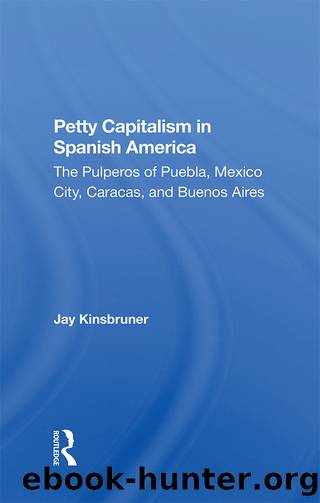
Author:Jay Kinsbruner [Kinsbruner, Jay]
Language: eng
Format: epub
Tags: International Relations, Political Science, General
ISBN: 9781000302257
Google: bKiaDwAAQBAJ
Goodreads: 46180370
Publisher: Routledge
Published: 2019-05-28T12:10:09+00:00
32 Ibid.
33 Ibid.
34 The grocery store owned by Don Tomás Ruiz in 1831 was valued at 9,121 pesos (ibid., Juzgado de Letras, Año-1834, "Los acreedores á la testama. del finado D. Tomás Ruiz..."). Naturally, such a store might be capitalized for significantly less. See, for example, ibid., 8 May 1846, "D. Manuel Martinez Solicitando esperas de sus acredores..."; and ibid., 3 Dec. 1855, "Balance...pertenece al Sr. D. Nicolas Qrtuño...."
35 See Table 4.
4
Problems of Grocery Store Ownership
Problems confronting the grocers were those intrinsic to the store's internal operation, such as credit and inventory acquisition, and those occasioned by external influences, primarily governmental interference. Some internal problems were mundane. in 1787 the Puebla grocers complained to the authorities that because "our trade is by nature excessively dirty, our clothing or uniform deteriorates much more than other people's; for its neatness and cleanliness additional costs are incurred."1 When underscoring the "leanness" of their capital in 1813, the Puebla grocers remarked that their inventories were being consumed by rats.2
Other problems were complex and not readily solved. Mexican grocers were particularly troubled by their employees and administrators.3 In Puebla at least one servant-porter (mozo) had to be employed to enable the grocer to leave the store "in search of daily inventory purchases."4 The salary and maintenance for such employees ascended to 16 pesos monthly, which is "the least we can give them, being men of worth and value." However, in addition, these employees pilfered.5 The owner of a Puebla grocery store informed an intendant's inquiry of 1807-1808 that he did not have a license because the person he had placed in charge of the store fled, carrying with him "papers, books and mote...."6 The administrator of another grocery store told the same inquiry that his predecessor had fled because of a discovery that had been made in the store.7 Perhaps illegal goods had been found, or perhaps in an inner patio he was operating a prostitution scheme, as female grocers in Santiago, Chile were accused of doing at the end of the colonial period.8
Administrators sometimes acquired debt that the owners considered unauthorized, as occurred when Don Manuel Alvarez de Palacios expanded the inventory for a grocery store and a wine store in Mexico City owned by the Licenciado Don José MarÃa de Torres y Cataño.9 Don Ramón Garrido administered a grocery store in Mexico City that suffered from a limited inventory. Like Alvarez, Garrido expanded the store's debt, precipitating a long and complex litigation with the deceased's family.10
Naturally, not all relationships between employees and owners ended in unpleasant litigation. Ranging through a broad spectrum of notary records, John Kicza deduced that in the whole of commerce, clerks "typically named their employers as executors and often as heirs."11 In 1787 Don José de Hoyo's clerk named him his heir.12
The Puebla grocers were troubled especially by two problems not originating in the store itself. The first was the previously mentioned pawning requirement, set in place by the viceroy in 1757 for Mexico City but apparently applicable in Puebla also.
Download
This site does not store any files on its server. We only index and link to content provided by other sites. Please contact the content providers to delete copyright contents if any and email us, we'll remove relevant links or contents immediately.
What's Done in Darkness by Kayla Perrin(26961)
The Ultimate Python Exercise Book: 700 Practical Exercises for Beginners with Quiz Questions by Copy(20859)
De Souza H. Master the Age of Artificial Intelligences. The Basic Guide...2024 by Unknown(20618)
D:\Jan\FTP\HOL\Work\Alien Breed - Tower Assault CD32 Alien Breed II - The Horror Continues Manual 1.jpg by PDFCreator(20539)
The Fifty Shades Trilogy & Grey by E L James(19465)
Shot Through the Heart: DI Grace Fisher 2 by Isabelle Grey(19382)
Shot Through the Heart by Mercy Celeste(19244)
Wolf & Parchment: New Theory Spice & Wolf, Vol. 10 by Isuna Hasekura and Jyuu Ayakura(17389)
Python GUI Applications using PyQt5 : The hands-on guide to build apps with Python by Verdugo Leire(17357)
Peren F. Statistics for Business and Economics...Essential Formulas 3ed 2025 by Unknown(17192)
Wolf & Parchment: New Theory Spice & Wolf, Vol. 03 by Isuna Hasekura and Jyuu Ayakura & Jyuu Ayakura(17103)
Wolf & Parchment: New Theory Spice & Wolf, Vol. 01 by Isuna Hasekura and Jyuu Ayakura & Jyuu Ayakura(16713)
The Subtle Art of Not Giving a F*ck by Mark Manson(14832)
The 3rd Cycle of the Betrayed Series Collection: Extremely Controversial Historical Thrillers (Betrayed Series Boxed set) by McCray Carolyn(14443)
Stepbrother Stories 2 - 21 Taboo Story Collection (Brother Sister Stepbrother Stepsister Taboo Pseudo Incest Family Virgin Creampie Pregnant Forced Pregnancy Breeding) by Roxi Harding(14224)
Cozy crochet hats: 7 Stylish and Beginner-Friendly Patterns from Baby Beanies to Trendy Bucket Hats by Vanilla Lazy(13506)
Scorched Earth by Nick Kyme(13100)
Reichel W. Numerical methods for Electrical Engineering, Meteorology,...2022 by Unknown(12980)
Drei Generationen auf dem Jakobsweg by Stein Pia(11264)
